


Managing Emotional Dysregulation Through Connection

COREGULATION: MANAGING EMOTIONAL DYSREGULATION THROUGH CONNECTION

Emotional dysregulation can be particularly disruptive to daily life when an individual has difficulty regulating their emotions in ways that are adaptive and appropriate. This can manifest in a variety of ways including intense or overwhelming emotions, mood swings, difficulty managing anger or frustration, impulsivity, self-destructive behaviors, difficulty recovering from negative emotions, and interpersonal problems. These symptoms can have a significant impact on an individual's quality of life, as well as relationships, work, and other important areas of functioning.

A mother kissing her daughter's cheek. If you experience anxiety, consider reaching out to a therapist in Missoula, MT. We offer anxiety counseling and individual therapy.

Emotional dysregulation can be caused by many factors, including genetic predisposition, brain development, trauma, environment, chronic stress, poor sleep, illness or injury, pain/discomfort, medication, and substance use.

The Nervous System

The autonomic nervous system (ANS) is responsible for regulating bodily functions that occur automatically and unconsciously. The nervous system informs emotional responses without conscious awareness. Understanding your nervous system and how it reacts automatically to social and environmental factors gives you the power to detect reflexive shifts and respond in ways that are safe and supportive in your relationship with yourself and others.

Understanding the ANS: Our Biological Response System 

The ANS is the control board for every response we have. It determines whether we embrace connection, run away, defend ourselves, or retreat into isolation. This biological control board is made up of two parts—the sympathetic nervous system, responsible for releasing adrenaline to fuel the “fight-or-flight” response, and the parasympathetic nervous system, responsible for the “freeze” response, “rest and digest” response, and the social engagement/connection system. The social engagement system is unique to mammals and is involved in regulating social interactions and communication. It is also thought to be involved in polyvagal coregulation, as it helps individuals synchronize their ANS responses and establish a sense of connection and trust.

Each ANS state is part of the human body’s biological response to protect.  Maladaptive behavior is, at its core, not a pathological deficit. Rather, it is an evolutionary function we employ as humans to survive.
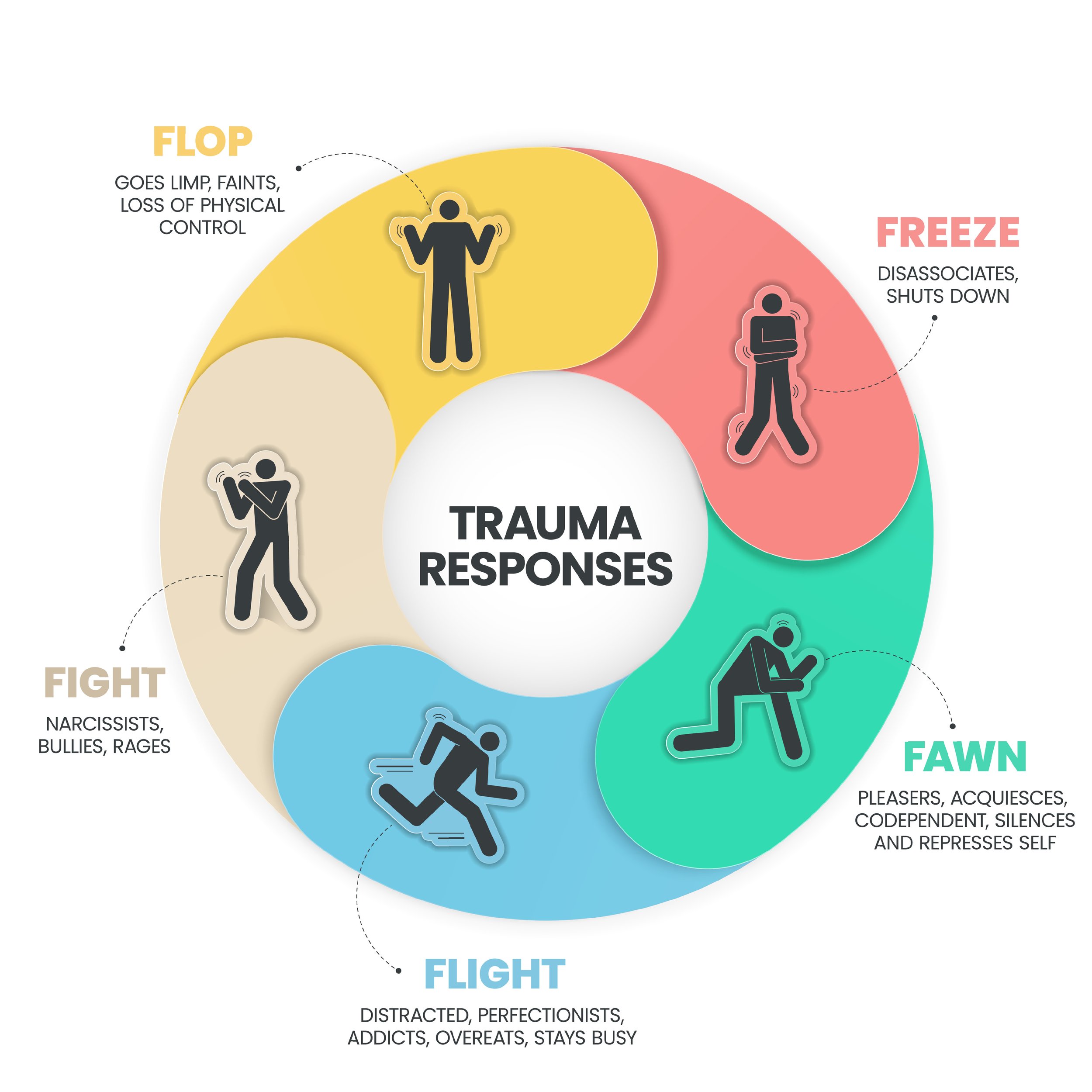
A trauma response wheel. With trauma therapy in Missoula, MT, you can heal from your childhood experiences. Call us today to get started with a trauma therapist.

Healing with Coregulation: Tips from a Trauma Therapist in Missoula, MT

In essence, coregulation is the syncing of nervous systems that allows humans to empathize and feel alongside one another. It is closely tied with neuroception, our unconscious “gut feeling” (termed by Stephen Porges’ Polyvagal Theory in 1994). Coregulation is the ultimate tool to create powerful connections and our first line of defense against emotional dysregulation. Knowing how to use it is the key to creating reciprocal understanding and healing through connection. Much of healing involves rewiring maladaptive (or lacking) defenses to recover connection and trust. Though early and persistent childhood experiences shape autonomic reactivity, people can rewire their response patterns and repair relationships, rebuild trust, and regulate emotions in a coordinated and mutually supportive way.

Coregulation Techniques:

Active Listening:

Make a conscious effort to hear not only the words that another person is saying but more importantly, the complete message being communicated. Staying present and practicing full attention, reflecting on what you have heard, and refraining from judgment can lead to deeper connection and empathy.

Awareness of Nonverbal Cues:

Nonverbal cues such as facial expressions, tone of voice, and body language can help individuals signal to each other how they are feeling and what they need. By paying attention to each other's nonverbal cues, we can better understand and respond to each other's needs and emotions.

Validation:

Emotional validation means acknowledging and accepting someone's emotions without judgment, even if we disagree. Through validation, we can confirm that others have their own emotional experiences and that those experiences are real, valued, and important. Feeling heard, understood, and cared for helps us feel safe; feeling safe allows us to express, process, and work through our emotions. 

Co-Regulated Breathing:

Co-regulated breathing involves two or more people mirroring their breathing patterns in a way that creates a sense of calm and relaxation. This can look like slowly inhaling together for 4 counts and exhaling fully at the same time for 8 counts.

Engage the Senses:

Engaging the senses through physical touch, sounds (including tone of voice and prosody), and singing, can help activate the PNS. Caring and gentle touch helps release oxytocin, lower heart rate, and slow breathing. 

A mother and daughter dancing in living room. Consider sharing activities with loved ones when needing to manage emotional dysregulation. Call us today to heal from past trauma & anxiety.

Move Together:

Engaging in shared activities, such as playing games or physical exercise. This can create a sense of mutual enjoyment and shared experience. Moving together synchronously with intentional awareness acts with the social engagement system and can help foster connection and trust.

What is Coregulation Used For?

Coregulation can occur in many contexts. This includes parent-child interactions, romantic relationships, work relationships, and friendships. It involves two or more individuals working together to regulate ANS responses in a way that promotes a sense of safety, comfort, and well-being. Coregulation is an important factor in promoting mental and physical health, as it can help reduce stress and build more resilient relationships. It is also a key component of effective therapy. If you’re interested in learning more about the benefits of therapy, explore Bridger Peaks Counseling. Our therapists offer counseling services to help individuals feel safe and supported while exploring difficult emotions and experiences.

Start Your Journey to Emotional Well-being: Embrace Coregulation Today!

Join Bridger Peak Counseling in building strong connections and empowering your overall well-being! Explore the power of coregulation for a healthier emotional life. Follow the few steps below to get started with an experienced therapist!

  1. Contact us so we can learn more about you!

  2. Learn more about our services here.

  3. Begin individual therapy and learn more coregulation tips.

Other Therapy Services, Workshops, and Resources from Bridger Peaks Counseling

In our Bozeman, MT counseling clinic, we can help you through several issues including anxiety, worry, stress, depression, and more. Our caring team of therapists is here for you and your loved ones. We offer addiction treatment, group counseling sessions, EMDR, and Somatic Experiencing for trauma therapy. More opportunities to explore coping patterns, marriage counseling, couples therapy, postpartum depression and anxiety counseling, mindfulness training, workshops, and more tools for client education. We also have a psychiatric nurse practitioner who can provide psychiatric care and medication. We look forward to talking with you soon!

Dana, D. 2018. The Polyvagal Theory in Therapy: Engaging the rhythm of regulation. W W Norton & Co.

Porges, S. W. (2011). The polyvagal theory: Neurophysiological foundations of emotions, attachment, communication, and self-regulation. W W Norton & Co.

Siegel, D. (1999). The developing mind: How relationships and the brain interact to shape who we are. New York: The Guilford Press.

van der Kolk, B. 2014. The Body Keeps the Score: Brain, Mind, and Body in the Healing of Trauma. Penguin


Styles of Communication in Relationships

STYLES OF COMMUNICATION IN RELATIONSHIPS

A long-term Harvard study of health and happiness in humans indicates that our relationships and how happy we are in our relationships have a powerful influence on our health. The study has indicated that close relationships, more than money, fame, or other socially lauded markers of success, are what keep people happy and healthy throughout their lives, suggesting that investing in the wellness of our relationships is one of the best forms of self-care.

Fostering and maintaining relationships relies heavily on our ability to effectively communicate with the people in our lives. While every person has their unique way of communicating, there are 4 basic communication styles: passive, aggressive, passive-aggressive, and assertive.

Building the capacity to identify which type you gravitate toward and which ones your partners or friends utilize can be supportive in navigating conflict and enhancing bids for connection. Being intentional about the communication style you utilize in a given interaction can significantly impact the way the communication is received. Thus, it is important to understand each style and why people use them.

Passive:

The passive communicator is commonly seen as the wallflower, frequently yielding to others. Passive communicators often default to “bottling up” emotions, either out of deference to others or due to being unaware of or ignoring their own thoughts, feelings, and desires. This communication style presents itself as “easygoing,” when in reality, they are often avoidant of conflict and fearful of disapproval from others. This shows up in relationships as defaulting to the other’s desires, avoiding being the decision maker, and refusing to take the lead - this person is likely the one who answers, “I don’t care, whatever you feel like” when asked what they want to eat or how they want to spend the day.

Aggressive:

A couple yell at one another representing the stress that relationship coaching in Bozeman, MT can help you overcome. Learn more about relationship counseling Bozeman, MT today by searching “relationship problems bozeman, mt” today.

The aggressive communicator is hard to miss - they are the “steamrollers” of the conversation. This communication style is often emphasized by loud speaking voice, direct eye contact and dominating or controlling of the conversation. The aggressive communicator tends to override others’ opinions, make demands and be critical, even hostile. They can tend to dominate conversations and activities by blaming, intimidating, threatening or attacking others. This shows up in our relationships through yelling, not considering others’ feelings in the moment and refusing to back down - you will often hear all or nothing phrases like “It’s my way or the highway,” “It’s all your fault,” “You never do anything right.”

Passive-Aggressive:

The passive-aggressive communicator is the one that leave you feeling baffled or confused.

Two kids tug for control of the same toy with angry expressions. Learn more about attachment styles and how relationship coaching in Bozeman, MT can offer support by searching “relationship problems Bozeman, MT” or relationship counseling Bozeman, MT

This communication style is usually a result of the person struggling to effectively voice their thoughts or emotions, which leads them to become frustrated, irritable, and resentful. This resentment is then acted out in an attempt to relieve their discomfort, coming across as indirect, critical, or sarcastic. This shows up as appearing indifferent when they are angry, denying a problem when it is clear they are upset - the difficulty acknowledging their emotions leads to non-verbals (facial expressions, body language) that don’t correlate with how they feel. The confusion of the mismatch of their body language and their words tends to alienate others. These communicators will be the ones giving you the silent treatment or undermining you behind your back.

Assertive:

The assertive communicator is the one who makes you feel heard and considered. Their style has openness, care, and strength without dominance. The assertive communicator can be considerate of differences while making their voice heard, without imposing on others. These communicators can express their own needs, ideas, desires, and feelings, while also considering those of the people around them. These communicators are not only great listeners, but they are equally equipped with confidence and security in sharing their opinions, thoughts, and feelings. Ultimately, they are good at having healthy boundaries when it comes to communication. The hallmark of an assertive communicator is that they can strike a balance between sharing and listening.

Assessing your own style:

While it is unlikely that you will be able to change someone else’s communication style, knowing how you interact and assessing your style of communication can support you in effective communication in your relationships. Understanding your style of communication can support you in making adjustments in your delivery if you find that your methods are clashing with your efforts to communicate with someone. A good place to start is to try and identify your default communication style - where do you land when you are not thinking about how you’re interacting? While being an assertive communicator is what we strive for, we may not naturally arrive there. Being able to be aware of your natural style of communication can be the first step in becoming more intentional about how we communicate, and thus, more effective in our relationships.

Slowing down:

An image of words drawn in the sand saying “slow down” next to the tide. Learn how relationship coaching in Bozeman, MT can support your relationship by contacting Bozeman counselors or searching for “relationship counseling bozeman, mt“

If you are finding that you are struggling to communicate effectively, often the first step is to slow down. Take a pause before responding, regardless of what communication style your partner, colleague or friend has, as not feeling heard is the most common reason most people do not communicate effectively. If you can slow down and respond with intention, reflecting what you have heard back to the other, you leave room for them to clarify what you have misunderstood or confirm your accurate understanding, leaving less room for misunderstanding leading to conflict. The act of slowing down and pausing, allows you to respond rather than react - a great first step in moving toward assertive communication.

Feeling Stuck? Begin Relationship Coaching in Bozeman, MT

Effective communication can be challenging, but it’s a challenge worth facing knowing that so much of our health and happiness is a result of our ability to engage in and hold close relationships. If you are feeling that you need help to improve your communication, our team of caring therapists would be honored to help you build your skills.

You can start your therapy journey with Bridger Peaks Counseling by following these simple steps:

  1. Contact us to speak with a staff member

  2. Meet with a caring therapist

  3. Start becoming the best version of yourself!

Other Therapy Services We Offer in Bozeman, MT

Our team of caring counselors at Bridger Peaks Counseling is happy to provide a variety of mental health services. Our team is happy to offer services including adult counseling, teen counseling, group therapy, rising strong workshops, and marriage counseling. Furthermore, we provide anxiety therapy, depression treatment, substance use counseling, and online grief counseling. Along with EMDR, postpartum depression support, body image therapy, and psychiatric care.